
How to Start Learning Torah: A Beginner's Guide
You want to start learning Torah, yet the ocean of text, commentaries, and traditions can feel endless before you open a single page. That hesitation is normal—and completely unnecessary. Torah study is regarded as equal to the sum total of all other mitzvahs, the living bridge that has kept Jewish communities connected to God and to one another across centuries. The good news is that you do not need years of yeshiva, perfect Hebrew, or hours of free time to begin.
What actually works for absolute beginners is far simpler: a tiny, fixed daily habit right after morning prayers, the weekly Torah portion read in any language, free digital libraries such as Sefaria packed with translations and classic commentaries, a teacher slightly ahead of you, a study partner for accountability, and—used carefully—modern AI companions that personalize questions without ever replacing a real Beit Midrash or live chavruta. This guide walks you through exactly those steps so you can start today, stay consistent, and keep turning the text for a lifetime.
- Start with a tiny fixed daily slot—ideally right after morning prayers—rather than waiting for a perfect long session.
- Use the weekly Torah portion as your accessible entry point: read it in any language, notice what stands out, and ask questions.
- Lean on free tools like Sefaria for text, translations, and 60+ commentaries including Rashi and Ramban.
- Follow Pirkei Avot: find a teacher slightly ahead of you and acquire a chavruta for discussion and accountability.
- Treat AI apps as optional on-ramps that must cite real sources and never replace live study or rabbinic guidance.
Why Torah Study Matters Even If You’re Starting from Zero

Torah study sits at the absolute center of Jewish life. It is not optional enrichment or an elite pursuit reserved for scholars and rabbis. Classic sources place it on a plane of its own: the study of Torah is equal to the sum total of all other mitzvahs. Far from a burden meant to intimidate newcomers, that ranking simply signals how central the practice is.
More than a checklist item, Torah forms the mysterious bridge connecting the Jew and God. History shows that every Jewish community that did not make teaching and studying Torah its first priority gradually disappeared from the scene. That same bridge still stands open today. Stepping onto it—even for a few unhurried minutes—delivers intellectual stretch, a lived link to Jewish peoplehood across centuries, and a quiet spiritual tether that strengthens with every return to the text.
The tradition never demanded perfection on day one; it only asks for the decision to start and keep returning. Personal growth, continuity with the Jewish people, and a real sense of connection all flow from that first small, consistent step. The rest of this guide shows exactly how to take it.
Start Small: Build a Torah Habit That Actually Sticks

That first step works best when it is deliberately tiny. Consistency beats duration every time: short fixed sessions, day after day, will carry you farther than the occasional heroic hour you never quite find. The goal is not to finish a tractate this week; it is to show up so reliably that Torah becomes part of the shape of your day.
Traditional sources are blunt about this. The Rambam requires every Jewish man to set aside time daily for Torah study, both during the day and at night, grounded in the verse “you shall meditate upon it day and night.” Ideally fix that study slot immediately after morning prayers, before the rest of life crowds in. Anchor the habit to something you already do and the decision fatigue disappears.
Treat the appointment the way you would any non-negotiable meeting. Block it on your calendar. Set a phone reminder with a clear label—“Torah, 8:15”—so the cue arrives without willpower. Many beginners also keep a simple streak counter (a paper calendar with checkmarks or a habit app) because visible progress is quietly motivating. When you miss a day—and you will—skip the guilt spiral. Just restart the next morning. A broken streak is information, not failure; the habit itself is the mitzvah.
Start with the weekly Torah portion if you like, or any short text that feels approachable. Read in whatever language lets the words land. Notice one phrase, ask one question, close the book. That is enough. Over weeks the small blocks compound, and the sense of connection the previous section described stops being abstract and starts feeling like home.
Make for Yourself a Teacher—and a Friend to Learn With

Once those small daily blocks start compounding, the next move is simple and ancient: do not try to carry the habit alone. Pirkei Avot 1:6 puts it plainly: “Make for yourself a teacher and acquire for yourself a friend.” For an absolute beginner that advice is not about finding a towering scholar or waiting until you feel ready. It is practical infrastructure that keeps the tiny habit alive.
A teacher, in this sense, is anyone even a half-step ahead of you. It can be the rabbi who answers a quick email, an adult-education instructor, a trusted podcast host whose weekly comments you follow, or a friend who simply started last year and already knows where the commentaries live. Their job is not to impress you with brilliance; it is to give you a living address for confusion, a model of how questions are asked, and gentle course-correction when you wander. Without that person the text stays flat; with them it starts talking back.
The friend—traditionally called a chavruta—is the partner who sits across from you, even if only on a screen. Studying alone is possible; studying with someone else multiplies the return. You gain built-in accountability (someone notices when you skip), multiple angles on the same verse, and an immediate cure for the isolation that makes beginners quit. Disagreement is not a bug; it is the method. Two people reading the same paragraph will notice different words, raise different objections, and push each other past the first shallow reading.
Finding either person is lower-barrier than most newcomers fear. Start at your local synagogue or Chabad house and simply say you are looking for a beginner study partner or a short weekly check-in. Online Jewish learning groups, community WhatsApp circles, and family members who already open a Chumash on Shabbat all work. Even a standing short call once a week counts. The goal is not perfection; it is having two human anchors—one slightly ahead, one beside you—so the daily habit you just built has somewhere solid to land.
Start with This Week’s Torah Portion
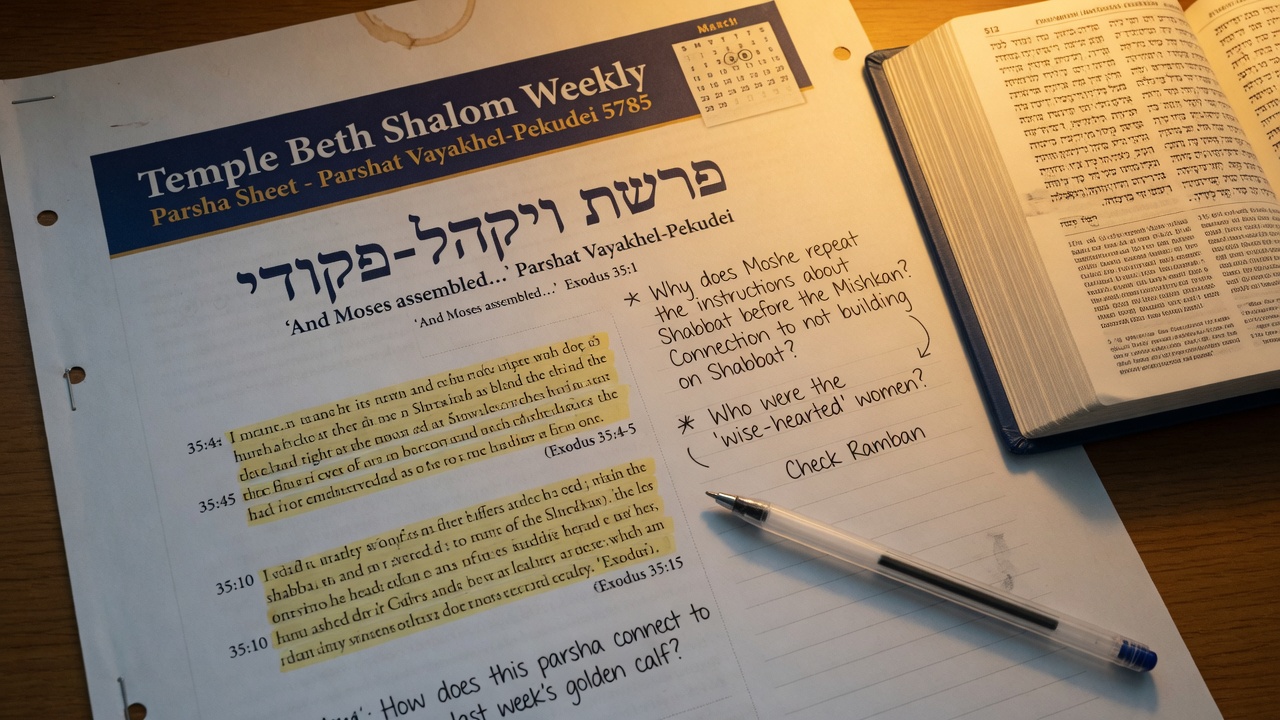
Those two human anchors give the daily habit somewhere solid to land—and the most natural landing spot is the weekly Torah portion, parashat hashavua. Every synagogue, every Jewish community on the planet is already reading the same stretch of text this week. That shared calendar makes the parsha the lowest-barrier, highest-reward entry point a beginner can choose. You do not need to invent a curriculum or master an entire library. You simply open the chapters the whole Jewish world is turning to right now.
Studying the weekly portion involves reading the Torah text in any language, noticing what seems interesting, asking questions, and looking for answers. That is the whole method. No advanced Hebrew, no prior scholarship required.
A clear four-step rhythm
- Read this week’s portion—or even just a few verses—in a translation you understand.
- Notice what stands out: a character’s choice, a strange detail, a repeated phrase, a law that feels personal.
- Ask questions out loud or on paper. Why this? What does it mean? How does it land for me right now?
- Seek answers in a short commentary, a conversation with your teacher or chavruta, or a brief class discussion.
There is no finishing line, and that is the point. Ben Bag Bag teaches: “Turn it over, and [again] turn it over, for all is therein. And look into it; And become gray and old therein; And do not move away from it, for you have no better portion than it.” Returning to the same text year after year is not repetition—it is the design. Each cycle reveals something new because you have changed. Lock your tiny daily or weekly habit onto this week’s parsha and you are already inside the living rhythm of Jewish learning.
Your Free Digital Beit Midrash: Sefaria and Everyday Supports
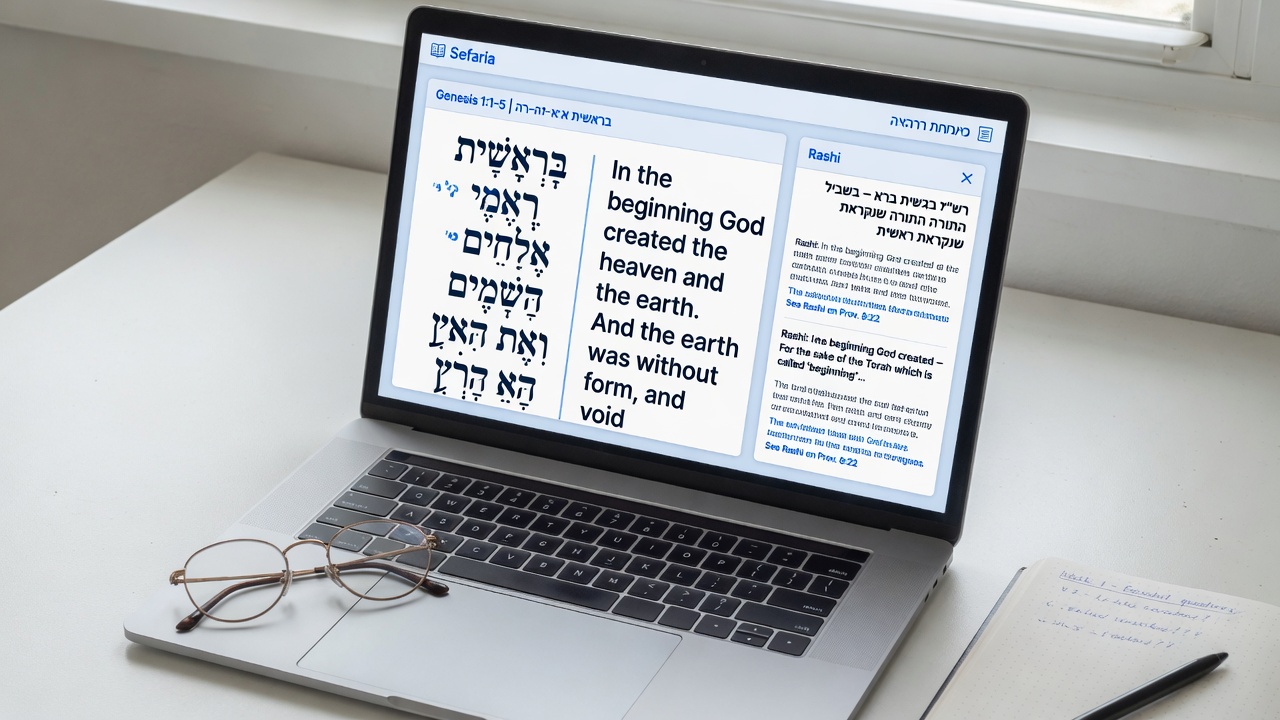
That living rhythm needs a reliable text in front of you, and the simplest place to open it is Sefaria. This free digital library puts the Torah, translations, and classic commentaries on any phone or laptop with no login required for basic reading. Beginners can treat it as their always-open beit midrash: search for this week’s parsha by name, or browse the Torah bookshelf and click straight into the current portion.
Once the text loads, switch the language toggle to any available English translation so you can follow along without Hebrew fluency. Click any verse to open a side panel of commentaries; Sefaria’s digital library includes more than 60 Torah commentaries in Hebrew or translation, including some of the most well-known such as Rashi and Ramban. Start with Rashi’s plain-sense notes, then expand a Ramban comment if a deeper layer catches your eye. Topic pages and linked web resources sit one click away when a theme—covenant, exile, mitzvah—pulls you further.
Keep the session tiny: open the parsha, read a few verses, glance at one Rashi, and close the tab. That is already a complete study block. To reinforce the habit without adding friction, pair Sefaria with other free supports—short daily-study apps that push a single verse or idea, or brief podcasts that walk through the weekly portion. Use them as gentle reminders, not replacements for the primary text. The goal remains the same: a fixed, low-pressure encounter with this week’s words, now backed by a library that never closes and never charges.
Using AI Wisely as a Torah Learning Companion

That same open library now sits beside a newer kind of helper. In recent years AI-powered platforms have begun offering themselves as personalized Torah companions—tools that can answer a quick question, quiz you on the week’s parsha, or shape a short learning path around what you already know. In 2026 the Orthodox Union launched OHRBIT, a free app built to personalize Torah study the way a music or language app personalizes playlists, drawing only on vetted OU and partner content. Used lightly, these tools can serve as low-friction on-ramps: a place to park curiosity between sessions with your teacher or chavruta, or a way to review what you just read on Sefaria.
They are not, and must never become, a substitute for live tradition. The OU itself is clear: OHRBIT “is absolutely not meant to replace learning in a Beit Midrash, studying from a real Gemara… or with a real chavruta. Nothing can, or should, do that.” The same caution applies to every other AI claiming to act as a virtual study partner. Torah is transmitted person to person; algorithms can surface sources but cannot embody the chain of responsibility that a teacher and a living community carry.
Simple rules that keep AI in its place
- Demand real citations. If the app cannot point you to a named sefer, daf, or classic commentator, treat the answer as unverified brainstorming.
- Use it for curiosity and review—never for final halachic decisions or sensitive personal guidance. Those questions go straight to a trusted rabbi.
- Double-check every striking claim against Sefaria or your teacher before you internalize it or share it.
- Keep your fixed daily habit anchored in the primary text and in human conversation; let the AI orbit that core rather than replace it.
When these boundaries stay firm, AI becomes just another optional support—like a well-indexed library card rather than a new authority. Start small tomorrow morning, stay consistent, and the ocean of Torah will keep inviting you deeper for the rest of your life.
Key Takeaways
Open this week’s parsha on Sefaria today, set a five-minute daily reminder, and reach out to one person who can learn beside you.